What Is a Chatbot and How Does It Actually Work?
You have probably chatted with one. The little window that pops up in the corner of a website asking if you need help. The assistant on your bank's app that answers questions about your account. The customer service bot that tells you your parcel is on its way.
Chatbots are everywhere. But have you ever stopped to wonder what is actually happening when you type a message and something types back?
Most people assume it is magic. Or AI. Or something so complicated that only engineers at big tech companies could possibly understand it. The truth is far more approachable — and once you understand how chatbots actually work, a lot of things about modern technology start to make a lot more sense.
Let's start at the beginning
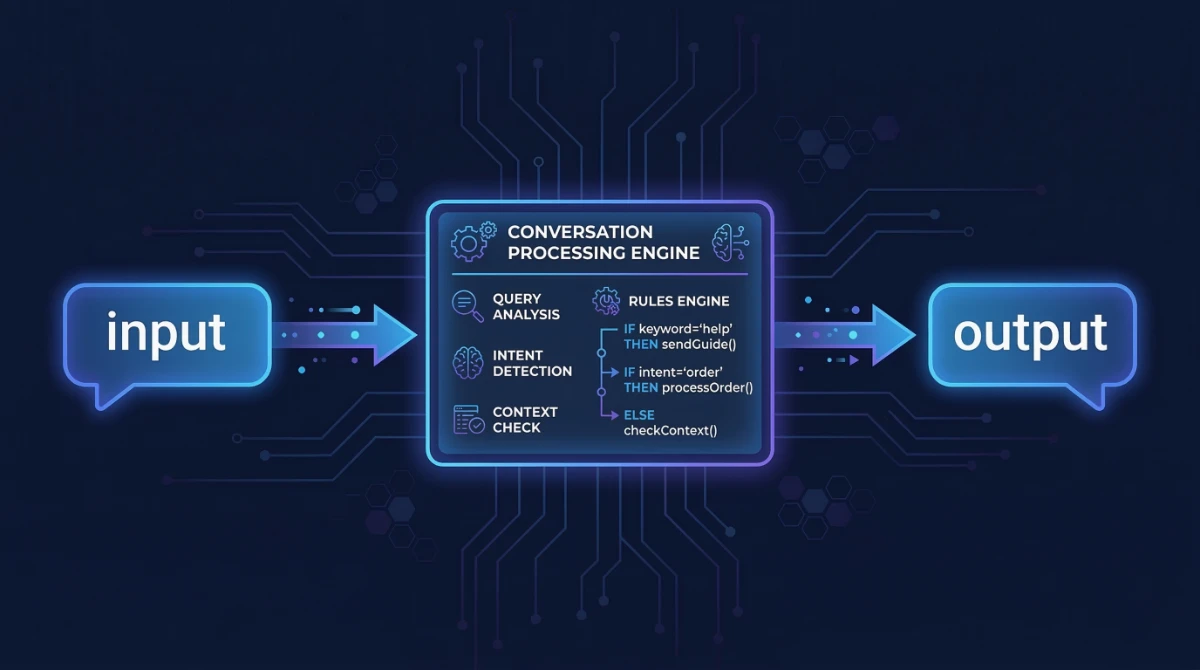
A chatbot is a program that receives a message and sends a reply. That is it. At its most basic level, nothing more complicated than that is happening.
The interesting question is: how does it decide what to reply?
There are two main approaches, and they are more different from each other than you might expect.
Rule-based chatbots
The first approach — and the one that powered most chatbots for decades — is called rule-based. The idea is simple: you write a set of rules that tell the bot what to say in response to specific inputs.
Think of it like a very organised game of if-then. If the user says "hello", reply with "Hi there!". If they say "what are your opening hours", reply with the opening hours. If they say "I want to make a complaint", hand them off to a human agent.
The rules can be as simple or as sophisticated as you like. Early chatbots worked with exact matches — the user had to type something precisely right for the bot to recognise it. Modern rule-based bots use keyword matching — they scan the user's message for trigger words and phrases and respond accordingly.
Here is what that might look like in plain English:
- If the message contains the word "hello" or "hi" — reply with a greeting
- If the message contains the word "price" or "cost" — reply with pricing information
- If the message contains the word "cancel" — reply with cancellation instructions
- If nothing matches — reply with a fallback like "I am not sure about that, can you rephrase?"
That last rule — the fallback — is important. A well-built rule-based chatbot always has something to say, even when it does not recognise the input. Without it, the bot would go silent, which is far more confusing for the user than an honest "I didn't understand that."
Rule-based chatbots are predictable, transparent, and easy to maintain. If a bot is giving the wrong answer, you find the rule that is causing it and fix it. They are used in customer service, FAQ bots, booking systems, and countless other applications where the range of likely questions is known in advance.
AI-powered chatbots
The second approach uses machine learning and large language models — the technology behind tools like ChatGPT, Claude, and Gemini. Instead of following hand-written rules, these bots have been trained on enormous amounts of text and have learned to generate responses that sound natural and relevant.
The difference in capability is significant. An AI-powered chatbot can handle questions it has never explicitly been trained on, carry a conversation across multiple turns, understand context, and produce responses that feel genuinely human.
But this power comes with trade-offs. AI chatbots can be unpredictable. They can say things that are wrong, unhelpful, or off-brand. They are more expensive to run. And when something goes wrong, it is much harder to trace exactly why.
For many applications — particularly ones where accuracy and consistency matter — rule-based approaches are still the right choice. And for many AI applications, a rule-based layer sits underneath the AI to handle specific, predictable cases before the more expensive AI system gets involved.
The two approaches are not opposites
Here is something that surprises a lot of people: AI chatbots and rule-based chatbots are not competing technologies. They are complementary ones.
Most production chatbots you interact with today use a combination of both. A rule-based layer handles the predictable stuff — greetings, common questions, routing to the right department. The AI layer handles the open-ended, conversational, hard-to-anticipate stuff.
Understanding one helps you understand the other. The people who build the best AI-powered systems are usually the ones who first understood the fundamentals — how messages are received, how responses are matched, how fallbacks work, how conversations are structured.
What goes into building a chatbot
Whether rule-based or AI-powered, every chatbot needs a few things:
- An input — a way for the user to send a message. On a website this is usually a text box. In an app it might be a voice interface.
- A processing layer — the logic that decides what the message means and what to do with it. For a rule-based bot this is the matching logic. For an AI bot this is the language model.
- An output — the reply that gets sent back to the user.
- A connection layer — something that connects the processing logic to the interface the user sees. In a web chatbot, this is usually a small server that sits between the browser and the processing logic, receiving messages from one and passing replies to the other.
For a surprisingly large number of chatbots in the real world, that connection layer is built with Python — specifically a lightweight framework called Flask. The processing logic is also Python. The interface is HTML and CSS. The same technologies you see taught in beginner courses are genuinely the ones being used in production.
Why this matters for you
Understanding how chatbots work changes how you interact with them. You start noticing when a bot is rule-based — the slightly rigid responses, the fallback when you phrase something unexpectedly. You start noticing when it is AI — the fluid, sometimes surprising replies.
More importantly, understanding the fundamentals means that if you ever want to build one yourself, you are not starting from zero. You already know what the pieces are. You just need to learn how to put them together.
The good news is that the core pieces are not as complicated as they might seem. A basic rule-based chatbot — one that reads your messages, matches them to a set of rules, and replies — can be built in Python with less code than you might expect. The keywords, the matching logic, the fallbacks, the conversation loop — all of it is learnable in a weekend.
And once you have built one yourself, even a simple one, everything else about chatbots — including the AI-powered ones — makes a lot more sense. Because you have seen the foundation. You know what is underneath.
That is a genuinely useful thing to know in a world where chatbots are only becoming more common.
Recommended Course
Build a fully working Python chatbot from scratch — complete with a web interface that runs in any browser. No experience needed. Every concept is explained in plain English, every step is covered in detail, and every lesson ends with something you can test immediately.
View Course Details